


Cored Wire
Zhen An: Leading Cored Wire Manufacture in China
ZhenAn International Co., Limited. is located in Anyang City, China, and has more than 30 years of experience and technology accumulation in the metallurgical industry.
Currently, Zhenan operates fully automatic and intelligent production lines for metallurgical and metal materials, with a stable annual output and sales volume of 150,000 metric tons.
Our factory covers an area of approximately 30,000 square meters, supporting stable and large-scale production.
Quality Assurance
Our quality inspectors strictly control the quality of each link to ensure that each batch of products meets international standards.
Good Service
Zhenan has an excellent and professional team dedicated to providing you with high-quality metallurgical product materials and services.
Customization
According to customer requirements, we also provide customized metallurgical material products with special specifications, shapes and materials.
Fast Delivery
With huge production capacity, we ensure in time delivery and transport to the destination in the first time.
Wide Range Of Applications
ZhenAn metallurgical materials products are widely used in casting, steelmaking, electricity, non-ferrous metals, petrochemicals, glass, building materials and other fields, and are exported to more than 80 countries and regions in the world.


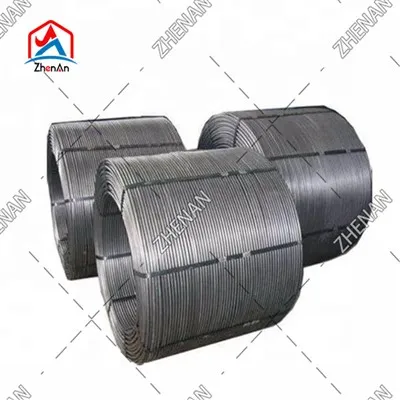


Cored wires are drawn from tubes filled with powder that is manufactured to introduce specific chemical or mechanical properties into the weld.
The primary advantage of this wire design is increased welding deposition rates. Cored wire can also be used to alloy the weld to compensate for high heat input and high dilution welds. In addition, the introduction of basic elements into the core composition can reduce oxygen content in the weld deposit to increase toughness.
The development and production of cored wires can be quite flexible and responsive. This helps meet evolving industry trends and application requirements, offering flexibility in some applications.
The Category of Products We Produce
Alloy Cored Wire
Alloy cored wire is made by ferro alloy powder wrapped in steel belt.According to the different powders in the steel belt, it is named CaSi cored wire, CaFe cored wire,FeSi cored wire,Ca metal cored wire etc.It can purify and improve the castability of the molten steel, and significantly improve the yield of the ferro alloy.
Metal Cored Wire
Metal-cored wire is a tubular wire filled with metallic powders, alloys and arc stabilizers, each of which offer distinct benefits such as lowering oxidation, providing higher impact strengths and reducing silicon deposits in the final weld.
Carbon Cored Wire
Carbon cored wire is a kind of alloy cored wire that is used in the steelmaking industry. It is to crush high-purity carbon raiser that needs to be added to the molten steel into certain particle sizes, then wrap them in a steel strip.

Advantages of Alloy Cored Wire
It is conducive to adjusting and controlling the content of easily oxidized elements and trace elements, which can greatly increase the alloy yield, reduce smelting costs, shorten smelting time, and accurately control ingredients.
It plays the role of purifying molten steel and partially changing the nature and shape of inclusions, improving the quality of molten steel and improving the casting state.
There are two types of cored wires: internally drawn type and external type. The mechanical equipment required for wire feeding is simple and reliable and takes up less space. In particular, the internally drawn cored wire is more suitable for use in narrow places.
Advantages of Metal Cored Wires
Because of the physical structure and the commonly used spray transfer mode, metal-cored wire produces a broad, cone-shaped arc, resulting in a wide penetration profile (compared to the more finger-like penetration of solid wire). This arc shape in turn creates a consistent bead profile that bridges gaps easily and accurately without burn-through. Another feature of metal-cored wire is the smaller droplets of liquid metal transferred across the arc, which result in less turbulence in the weld puddle.
Metal-cored wire offers faster travel speeds and higher deposition rates when compared to solid wire, resulting in increased productivity for welding operators. It’s also known to help minimize weld defects such as porosity, lack of fusion and undercut, which means using metal-cored wire may help reduce reject rates.
In addition, metal-cored wire has an increased ability to weld through mill scale and rust and still produce very little spatter, so it often helps eliminate the time and cost of activities before and after welding such as grinding, sand blasting or applying anti-spatter compound.


It is beneficial to control the carbon content of steel, the yield of carbon is greater than 90% and stable;
Reduce production cost and environmental pollution;
Storage time is long.
The Fundamentals of Metal-Cored Wire
Metal-cored wires are similar to flux-cored wires in that both types of filler metals have a tubular construction. However, metal-cored wires do not produce a slag that must be removed after each welding pass, resulting in a higher deposition efficiency and lesser post-weld cleaning as compared to flux-cored wires.
Metal-cored wires are filled with metallic powders, alloys and arc stabilizers. This composition can vary depending on the desired properties and characteristics such as lowering oxidation, achieving higher strengths and reducing silicon deposits on the weld metal.
Even though the technique for welding with metal-cored wire is comparable to that of solid wire, the metal-cored wire actually produces a different welding arc and weld profile characteristic. Because of its tubular construction, the welding current only passes through the outside metal sheath instead of through the entire cross-sectional area as with solid wire. Therefore, for the same welding current, the metal-cored wire will carry a higher current density. This gives metal-cored wires a wide penetration profile, as well as a higher deposition rate as compared to solid wire.
How Can Metal-Cored Wire Reduce The Hidden Costs Of Welding?
Metal-cored wire is capable of welding on a variety of material thickness (6mm and above, especially), which often makes it possible for companies to standardize on a single diameter wire throughout the welding operation. This standardization can help minimize inventory and the time associated with managing it, as well as reduce downtime for wire changeover. It also lowers hidden costs in other ways.
Metal-cored wire can weld through mill scale and rust and still produce very little spatter, so it helps eliminate activities like grinding, sand blasting or applying anti-spatter prior to welding. It can also reduce the need to degrease materials prior to welding. Not surprisingly, such pre-weld activities often cause bottlenecks that adversely affect the throughput of the fabricated part, reducing the overall productivity and profitability of the operation. Further, they add to expenses for abrasives (grinding wheels or sanding disks), grinding equipment and anti-spatter solution. Such activities may generate costs for additional labour and could lead to costly health and safety problems. For example, activities like grinding may cause greater operator fatigue and/or repetitive stress injuries that could increase insurance costs. Pre-weld activities like anti-spatter application can also create downtime for cleanup, since the solution is notoriously messy and frequently needs to be cleaned off of equipment and the floors.
The Importance of Cored Wire in Steel Production
Precise Alloying: Cored wire is a method of delivering various alloying elements directly into molten metal during steelmaking. It enables precise control over the composition of the steel, ensuring consistent and uniform alloying throughout the process.
Efficient Deoxidation and Desulfurization: Cored wire facilitates the introduction of deoxidizing and desulfurizing agents such as calcium, aluminum, and magnesium into the steel melt. This helps remove impurities, improve steel cleanliness, and enhance mechanical properties.
Enhanced Inclusion Modification: Cored wire can contain ingredients like rare earth metals, which aid in modifying non-metallic inclusions in steel. This results in improved steel quality, reduced susceptibility to defects, and enhanced mechanical properties.
Cost Efficiency: The use of cored wire reduces material waste and energy consumption compared to traditional bulk alloy additions. Its precise delivery system minimizes over-alloying and ensures optimal resource utilization, leading to cost savings in steel production.
Flexibility and Versatility: Cored wire technology offers flexibility in alloy selection and application, allowing steelmakers to tailor steel grades to meet specific performance requirements. It enables the production of specialized alloys for diverse industrial applications.
Cored Wire Manufacturing Process: How It Works
The first step in the cored wire manufacturing process is selecting the appropriate materials. The material used to produce cored wire must have certain properties, such as high purity, good fluidity, and the ability to dissolve easily in the molten steel. Some of the materials used include aluminum, calcium, carbon, magnesium, and silicon.
Once the materials are selected, they are mixed and blended in the correct proportions. The mixing process is essential to ensure that the final product has the desired properties. The mixing and blending process is done using specialized equipment, and the materials are carefully measured to ensure accurate proportions.
After the mixing and blending process, the cored wire is formed. This is done by placing the mixed materials inside a steel tube or sheath. The core wire diameter can vary depending on the application, and the sheath can be made from various materials, including steel, aluminum, and plastic.
The cored wire is then drawn to the desired size using specialized equipment. The drawing process is critical to ensure that the core wire has the correct diameter, length, and strength. During this process, the wire is pulled through a series of dies, which reduce its diameter while increasing its length.
Once the cored wire has been drawn to the desired size, it is coiled onto a spool. The coiling process is done using a machine that carefully winds the wire onto the spool. The spool is then labeled and packaged for shipping.
Applications of Alloy Cored Wire
1. Deoxidation
Alloy cored wire is used in steelmaking to treat oxygen in the steel, thus quickly reducing the oxygen content, reducing the generation of oxides, and improving the quality of steel.
2. Promote the fluidity of the steel, which can effectively promote the absorption and melting of raw materials in the steel, and enhance the chemical reaction between elements.
3. Maintain the high-temperature state of the steel, with a certain insulation effect.

Metal-cored wires have applications for which they are better suited than others. They are appropriate for welding on mild, low-alloy and stainless steel, but are not recommended for welding sheet metal. Metal-cored wires work particularly well in the automotive industry for welding components such as chassis and steel wheels, primarily due to their ability to provide a wide bead profile and higher travel speeds. In the manufacturing and fabrication industries, metal-cored wires are well-suited for welding agricultural and heavy equipment, as well as rail cars, mostly due to their ability to weld through rust and mill scale (the fine oxide layer found on hot-rolled steels) — both common factors encountered in these applications. The wires can also aptly weld on 6 mm and thicker plate found in agricultural and heavy equipment manufacturing applications, and are usable for applications in the food and chemical industry, which, conversely, tend to be composed of thinner materials.
In addition, metal-cored wires can often be used as an alternative on certain applications currently using the submerged arc or gas-shielded flux-cored welding processes, as well as on many of the same applications that employ solid wire. These include solid wire applications requiring single-pass welding for welds that are 7 cm or longer, and those applications welded in the flat and horizontal position using the spray transfer mode. On such solid wire applications, companies who choose to convert to metal-cored wires can often increase the wire diameter by one size over a solid wire. Doing so often lets them standardize on a single wire diameter within their facility and allows for welding on a variety of joint sizes and material thicknesses.
Metal-cored wires are typically not recommended for applications requiring a lot of out-of-position welding, but they are good for single- and multi-pass welding using a robotic or automatic welding process. Other applications where metal-cored wires can be used include welding piping or other components where poor fit-up occurs, applications prone to burn-through and those requiring aesthetic bead appearances.
Applications of Carbon Cored Wire
Carbon plays very important role for keeping the steel physical and chemical properties. It is mainly for keeping the steel strength. In reverse, Carbon adding reduces the steel toughness and weldability. Carbon content in the steel after smelting and refining is required to maintain around certain value. Feed Carbon cored wire can reach the final carbon content required by the steel. Carbon has low density and it is easy to suspend on the steel slag surface and thus burning waste happens. Carbon cored wire can be fed to the ladle bottom to avoid material waste and it can be dissolved in steel quickly and uniformly. The cored wire can also be used for components minor adjustment of low carbon steel.
Certifications


