


Ferro Silicon Nitride, also known as FeSiN or Ferrosilicon Nitride, is used as a functional additive in refractory materials such as blast furnace taphole clay, iron trough castables, ramming mixes and high-temperature lining systems.
Its value is not simply that it contains nitrogen and silicon. In refractory applications, Ferro Silicon Nitride works inside the refractory matrix, where it helps improve hot strength, erosion resistance, slag corrosion resistance and thermal shock stability under high-temperature service conditions.
For refractory producers, this means FeSiN should not be evaluated only by nitrogen content. Particle size, oxygen level, moisture, formulation compatibility and batch consistency also affect its final performance.

ZHEN AN supplies Ferro Silicon Nitride for refractory producers, steel plants and ironmaking-related applications.
For refractory-grade FeSiN, we focuses on stable N/Si content, controlled oxygen and moisture, suitable particle size and export-ready packing. Batch COA can be provided, and third-party inspection can be arranged before shipment if required.
If you need FeSiN for taphole clay, castables or refractory mixes, please send your required nitrogen content, particle size, quantity and application details.
1. Ferro Silicon Nitride Helps Strengthen the Refractory Matrix at High Temperature
In many refractory materials, strength at room temperature is not enough. The real challenge is whether the material can keep enough structural stability after repeated exposure to molten iron, slag and thermal cycling.
Ferro Silicon Nitride can help support the high-temperature bonding structure of the refractory matrix. When properly dispersed in the formulation, FeSiN contributes to a more stable structure during service.
This is especially important in blast furnace taphole clay, where the material must resist repeated opening, plugging, heating and erosion. If the matrix weakens too quickly, the taphole clay may crack, wash out or lose sealing performance.
2. Ferro Silicon Nitride Improves Erosion Resistance Against Molten Iron Flow
One of the main reasons FeSiN is used in taphole clay and iron trough materials is erosion resistance.
In ironmaking, refractory materials are exposed to high-temperature molten iron flow. If the working lining does not have enough resistance, the surface may gradually wear away, reducing service life and increasing maintenance frequency.
Ferro Silicon Nitride helps improve the integrity of the refractory body, making it more resistant to mechanical erosion under suitable formulation conditions. For taphole clay producers, this can mean better performance during repeated tapping cycles.
3. Ferro Silicon Nitride Supports Slag Corrosion Resistance
Refractories used in blast furnace and ironmaking systems are not only attacked by molten iron. They also face slag corrosion.
Slag can penetrate, react with or weaken the refractory structure. In this situation, FeSiN can help improve the refractory matrix and reduce the speed of structural damage when properly matched with other raw materials.
This does not mean Ferro Silicon Nitride alone can solve all slag corrosion problems. The final performance still depends on the full recipe, including aggregates, binders, carbon materials, antioxidants and particle size design.
4. Ferro Silicon Nitride Helps Improve Thermal Shock Stability
Thermal shock is another major problem in refractory applications. Taphole clay and furnace lining materials often experience repeated heating and cooling. If the material cannot tolerate this stress, cracks may form and expand.
Ferro Silicon Nitride can help improve high-temperature stability and reduce structural weakness caused by repeated thermal cycling. This is why FeSiN is often selected for applications where refractories must work under unstable temperature conditions.
For buyers, thermal shock stability is not just a laboratory concept. In actual use, it affects cracking, service stability and maintenance intervals.

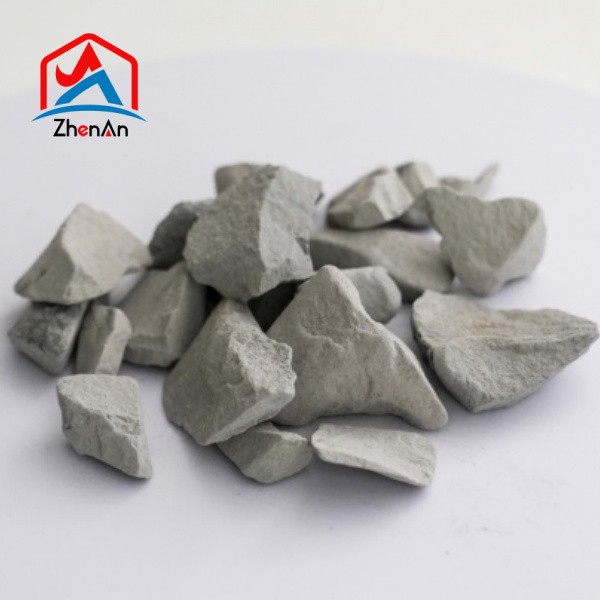

5. Particle Size Affects the Final Performance
A common misunderstanding is that FeSiN performance depends only on chemical composition. In reality, particle size is just as important.
Fine Ferro Silicon Nitride powder can disperse more evenly in refractory formulations, which is useful for taphole clay and castable matrix systems. Coarser particles may be selected for certain ramming mixes or special refractory designs.
Common particle sizes include:
| Particle Size | Typical Use |
|---|---|
| 200 mesh | Taphole clay and refractory matrix |
| 325 mesh | Fine refractory formulations |
| 0–1mm | Ramming mixes and taphole clay |
| 1–3mm | Coarser refractory systems |
| Customized | Based on buyer formulation |
For taphole clay, fine powder is often preferred because dispersion quality affects mixing uniformity and final service behavior.
6. Oxygen and Moisture Control Should Not Be Ignored
When buyers evaluate Ferro Silicon Nitride, they usually focus on N and Si content first. That is understandable, but not enough.
For refractory applications, oxygen level, carbon content, moisture and particle size distribution should also be checked. High moisture may affect storage and mixing. Unstable oxygen content may influence formulation behavior. Irregular particle size may create uneven distribution in the refractory body.
A practical FeSiN specification should include:
| Control Item | Why It Matters |
|---|---|
| N Content | Supports nitride phase contribution |
| Si Content | Related to silicon-based refractory structure |
| O Content | Affects oxidation-related behavior |
| Moisture | Important for storage and mixing stability |
| Particle Size | Affects dispersion and matrix uniformity |
| Batch COA | Confirms delivered material quality |
7. Where Ferro Silicon Nitride Is Commonly Used
Ferro Silicon Nitride is mainly used in refractory systems that need higher service stability under harsh conditions.
Common applications include:
blast furnace taphole clay;
iron trough castables;
refractory ramming materials;
furnace lining materials;
high-temperature refractory mixes;
selected ironmaking refractory systems.
Among these applications, taphole clay is one of the most important uses because the material must resist repeated tapping, molten iron erosion and thermal shock.
Conclusion
Ferro Silicon Nitride improves refractory performance mainly by strengthening the high-temperature matrix, supporting erosion resistance, improving slag corrosion resistance and enhancing thermal shock stability.
For refractory buyers, FeSiN should not be selected only by nitrogen content. The better approach is to evaluate chemical composition, oxygen level, moisture, particle size and formulation compatibility together.
When properly matched with the refractory recipe, Ferro Silicon Nitride can become an important additive for taphole clay, castables and ironmaking refractory materials.
FAQ
Q:What is Ferro Silicon Nitride used for in refractories?
A:Ferro Silicon Nitride is used as a refractory additive in taphole clay, castables, ramming mixes and furnace lining materials. It helps support hot strength, erosion resistance and thermal shock stability.
Q:Why is FeSiN used in taphole clay?
A:FeSiN is used in taphole clay because it helps strengthen the refractory matrix and improve resistance to molten iron erosion, slag attack and repeated thermal shock during tapping operations.
Q:Does Ferro Silicon Nitride only work because of nitrogen content?
A:No. Nitrogen content is important, but particle size, oxygen level, moisture and formulation compatibility also affect the final performance of Ferro Silicon Nitride in refractory materials.
Q:What particle size is suitable for refractory applications?
A:Common sizes include 200 mesh, 325 mesh, 0–1mm and customized sizes. Fine powder is often used in taphole clay and castable matrix systems for better dispersion.


