


Choosing between 88 silicon carbide and 90 silicon carbide depends on how the abrasive process is controlled and what kind of surface result is required. In abrasive applications, silicon carbide is not only selected based on hardness, but also on how it behaves during grinding, blasting, or polishing. This is why understanding the difference between 88/90 silicon carbide is important in real industrial use.
In practice, silicon carbide for abrasive applications is chosen based on cutting performance, wear behavior, and process stability. The difference between 88 and 90 grades becomes noticeable when the process requires either stronger cutting action or more controlled material removal.
What Problems Occur in Abrasive Applications When the Wrong Silicon Carbide Is Used?
In many abrasive processes, problems do not come from the machine itself, but from the abrasive material.
When silicon carbide for abrasive applications is not properly selected, several issues may appear:
- the cutting action is either too aggressive or too weak
- the surface finish becomes inconsistent
- abrasive consumption increases
- equipment wear becomes harder to control
If a higher grade like 90 silicon carbide is used in a process that requires control rather than intensity, the surface may be over-cut. On the other hand, if 88 silicon carbide is used where stronger cutting is needed, efficiency may drop.
These problems often lead to repeated adjustments and unstable results.
What Is the Difference Between 88 and 90 Silicon Carbide?
The main difference between 88 silicon carbide and 90 silicon carbide lies in purity and cutting performance.
90 silicon carbide generally provides stronger cutting action and higher hardness, making it suitable for processes where fast material removal is required. In contrast, 88 silicon carbide offers a slightly more moderate cutting effect, which can be easier to control in certain abrasive applications.
In real use, the difference is not only about composition, but about how the material behaves during the process. This is why 88/90 silicon carbide is often selected based on application conditions rather than just specifications.
When Should 88 Silicon Carbide Be Used in Abrasive Applications?
88 silicon carbide is often used in abrasive applications where control and consistency are more important than maximum cutting strength.
In processes such as surface preparation or controlled grinding, using 88 silicon carbide helps maintain a more stable removal rate. The cutting action is less aggressive, which reduces the risk of over-processing.
This makes 88 silicon carbide for abrasive applications suitable for:
- controlled surface finishing
- processes that require consistent results
- operations where excessive cutting needs to be avoided
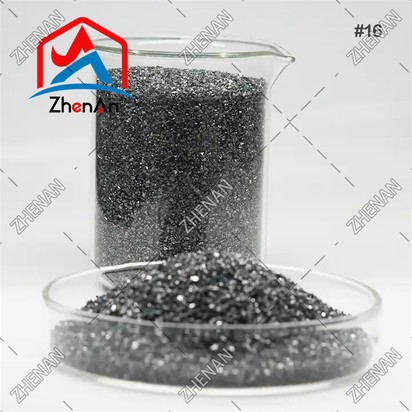
When Is 90 Silicon Carbide More Suitable for Abrasive Applications?
90 silicon carbide is typically used in abrasive applications where stronger cutting performance is required.
In processes such as heavy grinding or fast material removal, 90 silicon carbide provides higher efficiency. The stronger cutting action allows the process to remove material more quickly.
This makes 90 silicon carbide for abrasive applications suitable for:
- aggressive grinding operations
- high-efficiency material removal
- applications where speed is more important than fine control
Application Example: Choosing Between 88 and 90 Silicon Carbide in Sandblasting
In one sandblasting process, 90 silicon carbide was initially used to clean metal surfaces.
The issue was that the cutting action was too strong. While the surface was cleaned quickly, it also caused uneven texture and required additional finishing work. This increased both processing time and material consumption.
After switching to 88 silicon carbide, the process became more controlled.
The surface cleaning remained effective, but the removal rate was easier to manage. As a result:
- the surface finish became more consistent
- less rework was required
- overall abrasive consumption was reduced
This example shows how choosing between 88 and 90 silicon carbide for abrasive applications directly affects both process quality and cost.
How to Choose 88 or 90 Silicon Carbide for Different Abrasive Applications?
The choice between 88 silicon carbide and 90 silicon carbide depends on how the process is designed.
Key considerations include:
- whether the process requires strong or moderate cutting
- how sensitive the surface is to over-processing
- the required consistency of the final result
- the balance between efficiency and control
In abrasive applications, 88 silicon carbide is often chosen when control and consistency are needed, while 90 silicon carbide is selected when higher cutting efficiency is required.
Why Choose Our 88/90 Silicon Carbide for Abrasive Applications?
We supply 88 and 90 silicon carbide based on real abrasive application requirements.
Our products are processed to support stable performance in grinding, blasting, and surface treatment operations. With consistent quality, flexible sizing, and reliable supply, our 88/90 silicon carbide is suitable for a wide range of abrasive applications.
What Is the Main Difference Between 88 and 90 Silicon Carbide?
The main difference between 88 and 90 silicon carbide is how they balance cutting strength and process control.
- 88 silicon carbide → more controlled, stable, consistent
- 90 silicon carbide → stronger, faster, more aggressive
Choosing the right grade depends on the application, not just the specification.
ZHEN AN INTERNATIONAL CO.,LIMITED
ZhenAn is an enterprise specializing in Metallurgical & Refractory products , integrating production, processing, sales and importing and exporting business.
We are focused on building a dedicated team of professionals across the globe. At ZhenAn, we are committed to provide complete solutions by delivering the "right quality & quantity" to suite our customer's processes.
Annual production and sales more than 150,000 tons. Our factory covering an area of 30,000 square meters, it has a complete set of modern production equipment, two large production bases including hydro-metallurgy, two key laboratories and a metallurgical materials testing center with dozens of senior researchers.


