


What Is the Resistivity of Nickel Wire at 20°C?
The electrical resistivity of 99.99% pure nickel is approximately 6.844 × 10⁻⁸ Ω·m at 20°C. The same value can also be written as 6.844 μΩ·cm or 0.06844 Ω·mm²/m.
However, this is a reference value for very high-purity nickel. Commercial nickel wire does not always have exactly the same resistivity. Nickel 200, Nickel 201, nickel alloys, different material conditions and different test temperatures can all produce different values.
For example, published data for annealed Nickel 200 give a room-temperature resistivity of about 0.096 μΩ·m, while annealed Nickel 201 is listed at about 0.085 μΩ·m at 20°C.
| Nickel Material | Resistivity at 20°C | Equivalent Value |
| 99.99% Pure Nickel Reference | 6.844 × 10⁻⁸ Ω·m | 0.06844 Ω·mm²/m |
| Annealed Nickel 200 | 0.096 μΩ·m | 0.096 Ω·mm²/m |
| Annealed Nickel 201 | 0.085 μΩ·m | 0.085 Ω·mm²/m |
These values should be used as engineering references rather than as guaranteed values for every spool of nickel wire. If resistance is a controlled parameter, use the actual grade, material condition and test temperature specified for the wire.
What Does Nickel Electrical Resistivity Mean?
Electrical resistivity describes how strongly a material opposes the flow of electric current. It is an intrinsic material property and is normally represented by the Greek letter ρ.
A lower resistivity means that electrical current can move through the material more easily. A higher resistivity means more opposition to current flow.
Resistivity is commonly expressed in:
- Ω·m - SI resistivity unit;
- μΩ·cm - commonly used in material property tables;
- μΩ·m - also common in metal datasheets;
- Ω·mm²/m - particularly convenient for calculating wire resistance.
Conductivity describes the opposite property and is related to resistivity by:
σ = 1 / ρ
This means a material with lower resistivity has higher electrical conductivity.
Nickel Wire Resistivity Is Not the Same as Nickel Wire Resistance
This distinction is important when working with nickel wire.
Resistivity is a property of the nickel material. Resistance is a property of a specific piece of wire.
| Property | Meaning | Typical Unit |
| Resistivity, ρ | Intrinsic electrical property of the material at a specified temperature | Ω·m |
| Resistance, R | Opposition to current through a specific wire length and cross-sectional area | Ω |
| Conductivity, σ | Ability of the material to conduct electrical current | S/m |
Two nickel wires made from the same material can therefore have the same resistivity but completely different resistance if their diameters or lengths are different.
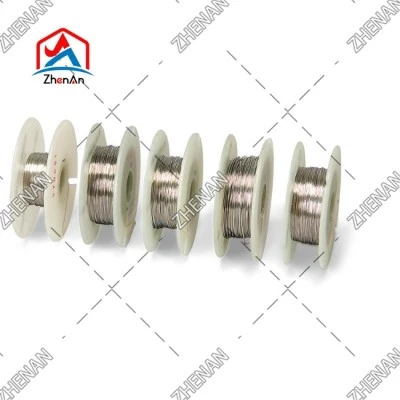
How Do Diameter and Length Affect Nickel Wire Resistance?
The resistance of nickel wire can be calculated from its resistivity, length and cross-sectional area:
R = ρL / A
where:
- R = wire resistance in ohms;
- ρ = electrical resistivity;
- L = wire length;
- A = cross-sectional area.
For a round nickel wire:
A = πd² / 4
Combining the two equations gives:
R = 4ρL / πd²
This relationship gives several useful engineering rules:
- doubling the wire length approximately doubles resistance;
- doubling the wire diameter increases area four times and reduces resistance to about one quarter;
- halving the diameter reduces area to one quarter and increases resistance by about four times.
Wire diameter therefore does not change the intrinsic resistivity of nickel, but it has a major effect on the actual electrical resistance of the finished wire.
How to Calculate the Resistance of Nickel Wire
For practical wire calculations, using resistivity in Ω·mm²/m is convenient because wire diameter is normally specified in millimeters.
Consider an illustrative 1-meter-long wire with a diameter of 0.20 mm.
Its cross-sectional area is:
A = π × 0.20² / 4 ≈ 0.0314 mm²
Using different published nickel resistivity values produces different calculated resistance:
| Material Reference | ρ, Ω·mm²/m | Calculated Resistance for 1 m × 0.20 mm Wire |
| 99.99% Pure Nickel | 0.06844 | Approx. 2.18 Ω |
| Annealed Nickel 200 | 0.096 | Approx. 3.06 Ω |
| Annealed Nickel 201 | 0.085 | Approx. 2.71 Ω |
This example shows why a nickel wire resistance calculator must start with the correct material resistivity. Using a pure elemental nickel value for commercial Nickel 200 wire can noticeably underestimate the calculated resistance.
Actual measured resistance may also differ because of diameter tolerance, temperature and material condition.
How Does Temperature Affect Nickel Wire Resistivity?
Nickel has a positive temperature coefficient of resistance over normal engineering temperature ranges. As temperature increases, its electrical resistivity generally increases.
For 99.99% nickel, a published temperature coefficient between 20°C and 100°C is approximately:
α ≈ 0.00636 /°C
For a limited temperature interval, resistivity can be estimated with:
ρT ≈ ρ20[1 + α(T − 20)]
This relationship explains why a nickel wire measured at 100°C has significantly more resistance than the same wire measured at 20°C.
However, the temperature coefficient is not a universal constant for every nickel grade. Purity and alloy composition change the resistivity-temperature relationship, and nickel does not remain perfectly linear across a very wide temperature range.
For elevated-temperature design, use the resistivity data for the actual nickel grade at the relevant operating temperature instead of extrapolating indefinitely from a room-temperature value.
Why Do Nickel Resistivity Values Differ Between Data Sheets?
Different nickel resistivity values do not necessarily mean that one source is wrong. They often refer to different materials or test conditions.
Nickel Purity and Grade Change Electrical Resistivity
Very high-purity elemental nickel has fewer impurity atoms to scatter conduction electrons. Commercially pure grades contain controlled amounts of other elements, so their electrical resistivity can be higher.
Nickel 200 and Nickel 201 are both commercially pure nickel grades, but their published electrical values are not identical. Nickel alloys can differ even more because alloying additions substantially change electrical behavior.
If you need to distinguish Nickel 200, Nickel 201 and other material designations, the different grades of nickel wire should be evaluated separately rather than treated as one generic nickel material.
Nickel Material Condition Can Affect Resistivity
Cold working, annealing and other processing conditions change the metallic structure. Published material-property tables therefore often identify whether the reported value applies to annealed or otherwise processed material.
When comparing two data sheets, check that the material condition is comparable before concluding that the values conflict.
Nickel Resistivity Must Be Compared at the Same Temperature
A resistivity value reported at 20°C should not be directly compared with one measured at 100°C.
Because nickel resistance changes significantly with temperature, the reference temperature is an essential part of any meaningful resistivity specification.
Nickel Resistivity Units Can Look Different
The same physical value can appear numerically different simply because another unit system is being used.
For example:
6.844 × 10⁻⁸ Ω·m = 6.844 μΩ·cm = 0.06844 μΩ·m = 0.06844 Ω·mm²/m
Always convert the units before comparing values from different sources.
Is Nickel More Conductive Than Copper?
No. Copper has substantially lower electrical resistivity and therefore higher conductivity than nickel.
At 20°C, the International Annealed Copper Standard has a resistivity of approximately 1.7241 × 10⁻⁸ Ω·m, compared with approximately 6.844 × 10⁻⁸ Ω·m for 99.99% pure nickel.
| Property at 20°C | 99.99% Nickel | Annealed Copper Standard |
| Resistivity | Approx. 6.844 × 10⁻⁸ Ω·m | Approx. 1.7241 × 10⁻⁸ Ω·m |
| Relative Resistivity | About 4× copper | Reference |
| Relative Conductivity | About 25% of copper reference | 100% IACS reference |
Copper is therefore more suitable when minimum electrical resistance is the dominant requirement.
This does not mean nickel is a poor engineering material. Nickel may still be selected where electrical performance must be balanced with corrosion resistance, temperature behavior or material compatibility. Those application decisions are separate from the basic resistivity comparison.
What Should You Specify When Nickel Wire Resistance Matters?
If actual wire resistance is important to your design, specifying only "pure nickel wire" and nominal diameter is not enough.
The RFQ should identify the electrical and dimensional conditions that control the final resistance:
- Nickel grade: identify the approved material designation.
- Wire diameter: specify nominal diameter and tolerance because resistance depends on cross-sectional area.
- Electrical requirement: state resistivity, resistance per meter or another measurable electrical limit if required.
- Reference temperature: define the temperature at which the resistance requirement applies.
- Wire length: required when total resistance rather than resistance per unit length is controlled.
- Material condition: identify annealed, drawn or another required condition where applicable.
For the broader dimensional, grade, COA and delivery requirements associated with pure nickel wire specifications, those purchase items should be confirmed separately from the electrical calculation itself.
If resistance is critical, the most useful RFQ is one that states both the material specification and the measurable electrical requirement.
Resistivity of Nickel Wire FAQ
Q1: What is the resistivity of pure nickel?
The electrical resistivity of 99.99% pure nickel is approximately 6.844 × 10⁻⁸ Ω·m at 20°C, equivalent to 6.844 μΩ·cm or 0.06844 Ω·mm²/m.
Q2: What is the resistivity of Nickel 200 wire?
Published data for annealed Nickel 200 give a typical value of about 0.096 μΩ·m at 20°C. Actual wire should be evaluated against the applicable material and electrical specification rather than using this value as a universal guarantee.
Q3: Does nickel wire diameter change its resistivity?
No. Diameter does not directly change the intrinsic resistivity of the nickel material. It changes the wire's cross-sectional area and therefore changes its total electrical resistance.
Q4: Does longer nickel wire have more resistance?
Yes. For the same grade, diameter and temperature, electrical resistance is directly proportional to wire length. A wire twice as long will have approximately twice the resistance.
Q5: Does nickel wire resistivity increase with temperature?
Generally yes. Nickel has a positive temperature coefficient, so resistivity normally increases as temperature rises. The exact relationship depends on purity, grade and temperature range.
Q6: Why do Nickel 200 and Nickel 201 have different resistivity values?
Their chemical composition and published material conditions are not identical. Even commercially pure nickel grades can therefore have different measured electrical resistivity.
Q7: Is nickel more conductive than copper?
No. At about 20°C, 99.99% pure nickel has roughly four times the resistivity of the annealed-copper reference and approximately one quarter of its electrical conductivity.
Q8: Is pure nickel considered a high-resistance wire material?
Pure nickel has higher electrical resistivity than copper, but it should not be confused with purpose-designed resistance alloys. Whether its resistance is high or low enough depends on the required wire geometry, temperature and circuit design.
Need to Control Nickel Wire Resistance?
Send the nickel grade, wire diameter and tolerance, required length, operating temperature and electrical resistance requirement. We can review the available wire specification before quotation.
Confirm Your Nickel Wire Spec Email Your RequirementZhenAn supplies pure nickel wire and nickel alloy wire for industrial requirements. We can confirm material grade, diameter tolerance, delivery condition, packing and batch documentation according to the agreed specification.


