


Does Nickel Conduct Electricity? The Short Answer
Yes. Nickel conducts electricity and is an electrical conductor, not an insulator. However, nickel is significantly less conductive than copper. Reference data for very high-purity nickel at about 20°C give an electrical conductivity of roughly 14.6 MS/m, compared with about 58 MS/m for annealed copper.
That means high-purity nickel conducts electricity at roughly one quarter of the conductivity of the standard annealed-copper reference.
This does not make nickel unsuitable for electrical applications. Conductivity is only one material-selection factor. Nickel wire may still be preferred when electrical performance must be combined with corrosion resistance, temperature capability, material compatibility or other mechanical and processing requirements.
The important distinction for engineering work is that nickel conductivity is a material property, while the resistance of an actual nickel wire also depends on its grade, temperature, length and cross-sectional area.
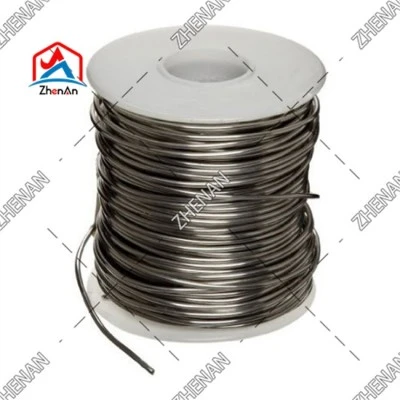
How Conductive Is Nickel Compared With Copper?
Nickel is conductive, but copper carries electrical current with much lower resistive loss when the two materials are compared at the same dimensions and temperature.
| Electrical Property | High-Purity Nickel Reference | Annealed Copper Reference |
| Electrical Conductivity at About 20°C | Approx. 14.6 MS/m | Approx. 58 MS/m |
| Electrical Resistivity at About 20°C | Approx. 6.84 × 10⁻⁸ Ω·m | Approx. 1.72 × 10⁻⁸ Ω·m |
| Approximate IACS Equivalent | About 25% | 100% |
| Relative Electrical Performance | Conductive, but with higher resistance | High-conductivity reference material |
These values should be treated as material references rather than guaranteed values for every nickel wire product. Commercially pure nickel grades, impurities, cold working, temperature and material condition can change the measured resistivity.
For the same length and cross-sectional area, high-purity nickel will therefore have roughly four times the electrical resistance of annealed copper when these room-temperature reference values are used.
Why Does Nickel Conduct Electricity?
Nickel conducts electricity because it is a metal with mobile electrons that can respond to an applied electric field.
In metallic nickel, electrons are not confined to individual atoms in the same way they are in an insulating material. Electrical energy can therefore move through the metallic structure as charge carriers travel through the crystal lattice.
This is why nickel belongs to the conductor category rather than the semiconductor or insulator category.
However, being a conductor does not mean that every metal conducts equally well. The electrical resistance of a metal depends on how easily electrons can move through its electronic and crystal structure without being scattered.
Why Is Nickel Less Conductive Than Copper?
Copper has lower electrical resistivity because its electronic structure allows conduction electrons to move through the metal with less resistive scattering under ordinary conditions.
Nickel has a different electronic structure, including partially filled 3d electronic states and magnetic interactions. These contribute to greater electron scattering and therefore higher electrical resistivity.
The difference should not be reduced to a simple statement such as "copper has more free electrons." Electrical conductivity depends not only on the number of available charge carriers but also on how effectively those electrons move through the material.
For electrical designs where minimum resistance is the main requirement, copper will usually have the advantage. Where other material properties are equally important, nickel can still be the better engineering choice.
What Affects Nickel Electrical Conductivity?
A single conductivity value cannot describe every nickel wire under every operating condition. Temperature, purity, nickel grade, alloying and material condition can all influence electrical performance.
How Temperature Changes Nickel Electrical Resistance
Like most metallic conductors, nickel generally becomes more electrically resistive as temperature rises. Increased lattice vibration creates more scattering for conduction electrons.
This effect can be significant. Published data for annealed Nickel 200, for example, show substantially higher resistivity at elevated temperature than at room temperature.
For this reason, a room-temperature conductivity value should not be used directly for a high-temperature electrical design without checking grade-specific data at the actual operating temperature.
How Purity and Nickel Grade Affect Electrical Conductivity
Impurities disturb the regular metallic lattice and can increase electron scattering. A very high-purity nickel reference value therefore should not automatically be applied to every commercially pure nickel wire.
Nickel 200, Nickel 201 and other pure nickel grades have controlled but different chemical compositions. Their electrical properties can also vary with manufacturing condition and temperature.
If electrical resistance is critical, the purchase specification should identify the actual grade and electrical requirement rather than relying only on the phrase "pure nickel wire."
How Alloying Changes Nickel Wire Conductivity
Nickel alloy wire should not be treated as electrically equivalent to pure nickel wire.
Adding chromium, copper, iron, molybdenum or other alloying elements changes the electronic structure and increases or otherwise modifies electrical resistivity. Some nickel alloys are deliberately designed to provide much higher resistance than commercially pure nickel.
For example, NiCr resistance wire is selected for a completely different electrical function from Nickel 200 or Nickel 201 wire.
This is why the exact alloy designation matters when comparing nickel wire conductivity.
How Nickel Wire Condition Can Affect Electrical Performance
Material processing can also influence resistivity. Cold working introduces defects and strain into the crystal structure, while annealing changes the material condition.
The effect may be smaller than changing from pure nickel to a heavily alloyed nickel material, but it still matters where resistance must stay within a narrow engineering tolerance.
Does Nickel Wire Diameter Affect Conductivity?
Wire diameter does not directly change the intrinsic electrical conductivity or resistivity of nickel, but it strongly changes the electrical resistance of the finished wire.
For a uniform wire:
R = ρL / A
where:
- R = electrical resistance;
- ρ = material resistivity;
- L = wire length;
- A = cross-sectional area.
For a round nickel wire:
A = πd² / 4
This means resistance changes approximately with the inverse square of wire diameter when material, length and temperature remain the same.
If the diameter is doubled, the cross-sectional area becomes four times larger and the wire resistance falls to approximately one quarter. If the diameter is cut in half, the resistance becomes approximately four times higher.
This relationship becomes particularly important with very fine wire. For products such as 0.025mm pure nickel wire, even a small dimensional change represents a meaningful percentage change in cross-sectional area and therefore in calculated resistance.
Nickel Conductivity Is Not the Same as Nickel Wire Resistance
Conductivity and resistance describe related but different things.
| Term | What It Describes | Affected by Wire Diameter? |
| Electrical Conductivity, σ | How readily the material conducts electrical current | No, not directly |
| Electrical Resistivity, ρ | Intrinsic opposition of the material to electrical current | No, not directly |
| Wire Resistance, R | Resistance of a specific piece of wire | Yes |
Two nickel wires made from the same grade can therefore have essentially the same material resistivity but very different total resistance if their diameters or lengths are different.
The same distinction applies to current-carrying capability. Conductivity alone does not determine how much current a wire can safely carry. Wire diameter, allowed temperature rise, cooling, contact resistance, installation condition and duty cycle also matter.
Why Use Nickel Wire If Copper Conducts Electricity Better?
Copper is the stronger choice when maximum electrical conductivity and minimum conductor resistance dominate the design.
Nickel wire is selected when conductivity must be balanced with other material requirements.
| Design Requirement | Why Nickel Wire May Be Evaluated |
| Corrosion Environment | Commercially pure nickel has useful corrosion resistance in selected chemical environments where copper may not be the preferred material |
| Elevated Temperature | Certain nickel grades can provide a useful combination of electrical, mechanical and chemical stability at elevated temperature |
| Material Compatibility | Nickel may match an existing component, joining process or service environment better than copper |
| Higher Electrical Resistance | Some designs do not require the lowest possible resistance and may benefit from nickel's higher resistivity compared with copper |
| Fine-Wire Processing | Nickel is available in fine wire forms where grade, surface condition, diameter tolerance and winding consistency can be controlled together |
The engineering question is therefore not simply "Which metal conducts better?" It is "Which material provides the required electrical performance together with the chemical, thermal, mechanical and processing properties of the application?"
Which Nickel Wire Grade Should You Evaluate for Electrical Use?
The word "nickel wire" can describe several materially different products. Grade should therefore be confirmed before comparing electrical performance.
Nickel 200 Wire and Electrical Performance
Nickel 200 is a commercially pure nickel grade used where the combination of nickel's electrical properties, corrosion resistance and mechanical characteristics is required.
Published room-temperature resistivity data for commercial Nickel 200 are higher than the reference value for 99.99% pure elemental nickel. This illustrates why an elemental property table should not be treated as a guaranteed Nickel 200 wire specification.
Nickel 201 Wire and Electrical Performance
Nickel 201 is closely related to Nickel 200 but has a lower carbon limit. It is commonly evaluated when elevated-temperature service makes carbon-related behavior an important material-selection factor.
Nickel 200 and Nickel 201 should not be selected only from a general statement that both are conductive. Operating temperature, chemical environment, wire condition and the required resistance range should also be considered.
For a broader comparison, the different grades of nickel wire should be separated by material designation rather than grouped together only by nickel content.
Nickel Alloy Wire vs Pure Nickel Conductivity
Nickel alloy wire can have very different electrical behavior from commercially pure nickel.
Monel, Inconel, nickel-chromium and other nickel alloys contain deliberate alloying additions that change resistivity, corrosion behavior, mechanical strength and temperature performance.
A specification such as "high nickel wire" is therefore not precise enough when electrical performance is important. The actual alloy designation should be confirmed first.
What Should Buyers Specify for Conductive Nickel Wire?
If nickel wire will form part of an electrical circuit, the purchase specification should go beyond material name and nominal diameter.
- Nickel grade: specify Nickel 200, Nickel 201 or another approved grade.
- Wire diameter and tolerance: resistance depends strongly on cross-sectional area.
- Electrical requirement: state maximum resistivity, minimum conductivity or required resistance per unit length when it is a critical design parameter.
- Reference temperature: electrical resistance should be associated with a defined test or operating temperature.
- Delivery condition: confirm annealed, hard-drawn or another required material condition.
- Surface and winding: confirm finished-wire condition when the wire will be joined, fed or processed automatically.
- Batch documentation: confirm the required COA or MTC and ensure the material grade matches the approved specification.
For industrial sourcing, our pure nickel wire supply requirements cover grade, diameter, tolerance, delivery condition, packing and batch documentation. Where electrical performance is critical, include the required resistance or resistivity target in the RFQ so it can be reviewed with the material specification.
Does Nickel Conduct Electricity FAQ
Q1: Is nickel a conductor or an insulator?
Nickel is an electrical conductor. It allows electric current to flow through its metallic structure, although its conductivity is substantially lower than that of copper.
Q2: Is nickel a good conductor of electricity?
Nickel is conductive, but it is not normally classified with very high-conductivity metals such as copper or silver. Very high-purity nickel has roughly one quarter of the conductivity of the standard annealed-copper reference at about room temperature.
Q3: What is the electrical conductivity of nickel?
A reference value for very high-purity nickel at about 20°C is approximately 14.6 MS/m. Actual Nickel 200, Nickel 201 and nickel alloy wire can have different values because grade, impurities, temperature and material condition affect resistivity.
Q4: Does a thicker nickel wire conduct electricity better?
The intrinsic conductivity of the nickel does not increase simply because the wire is thicker. However, a thicker wire has a larger cross-sectional area and therefore lower total electrical resistance for the same grade, length and temperature.
Q5: Does nickel become less conductive when it gets hot?
Generally yes. Metallic nickel's electrical resistivity increases as temperature rises, so its conductivity decreases. Grade-specific temperature data should be used for elevated-temperature calculations.
Q6: Why use nickel wire instead of copper wire?
Nickel may be selected when the application requires electrical performance together with corrosion resistance, elevated-temperature capability, material compatibility or other processing requirements. Copper remains preferable when maximum conductivity is the dominant requirement.
Evaluating Nickel Wire for an Electrical Application?
Send the required nickel grade, wire diameter and tolerance, operating temperature, electrical requirement, quantity and spool format. We can help confirm the available wire specification and batch documentation before quotation.
Confirm Your Nickel Wire Spec Email Your RequirementZhenAn supplies pure nickel wire and nickel alloy wire for industrial applications. We can confirm material grade, diameter, tolerance, delivery condition, packing and batch COA/MTC according to the agreed purchasing specification.


